
Dolby Atmos Certified Service Partner
We are the only company in Poland that is a certified Dolby Atmos partner. What does this mean? We design, install, integrate and support mixing studios
Dolby Atmos.
With us you will launch and calibrate your Dolby Atmos studio.
Mix in Dolby Atmos
Project
Calibration
Benefits
Broadcast
Project
ROOM PREPARATION FOR DOLBY ATMOS
Dolby has prepared a series of recommended guidelines for rooms designed to work with Dolby Atmos sound . Already at the design stage, care should be taken to ensure that the subsequent calibration process takes place without problems.
GET READY TO WORK WITH DOLBY ATMOS
Even at the planning stage of building, adapting or upgrading your studio, you can use free tools that will outline the optimal way to work with Dolby Atmos.
The Dolby Atmos Room Design Tool HE+Music (DARDT HE+Music) is an interactive Microsoft Excel spreadsheet that allows users to enter the dimensions of the space they are working in, speaker locations, and speaker and amplifier details to help design and model a Dolby Atmos mixing studio for music, post-production, gaming, podcasting and other applications.
Version 6.2 builds on the work from version 6.0 and adds a Design Feedback section that lists design problems and suggested solutions, a new speaker manufacturer filter, additional design layout guides, and a speaker delay calculator in the Startup tab.
The new version and full release notes can be downloaded via the links below:
DARDT v6.2.0 HE+Music Release notes
When using DARDT HE+Music, we recommend reading the document How to Design a Dolby Atmos Mix Room and watch a series of video tutorials Room Design and DARDT.
Opinions and questions can be posted on the forum Room Design & Calibration Forum.
At any stage of the project, you can contact our engineers, who are eager to help you enter the world of Dolby Atmos.
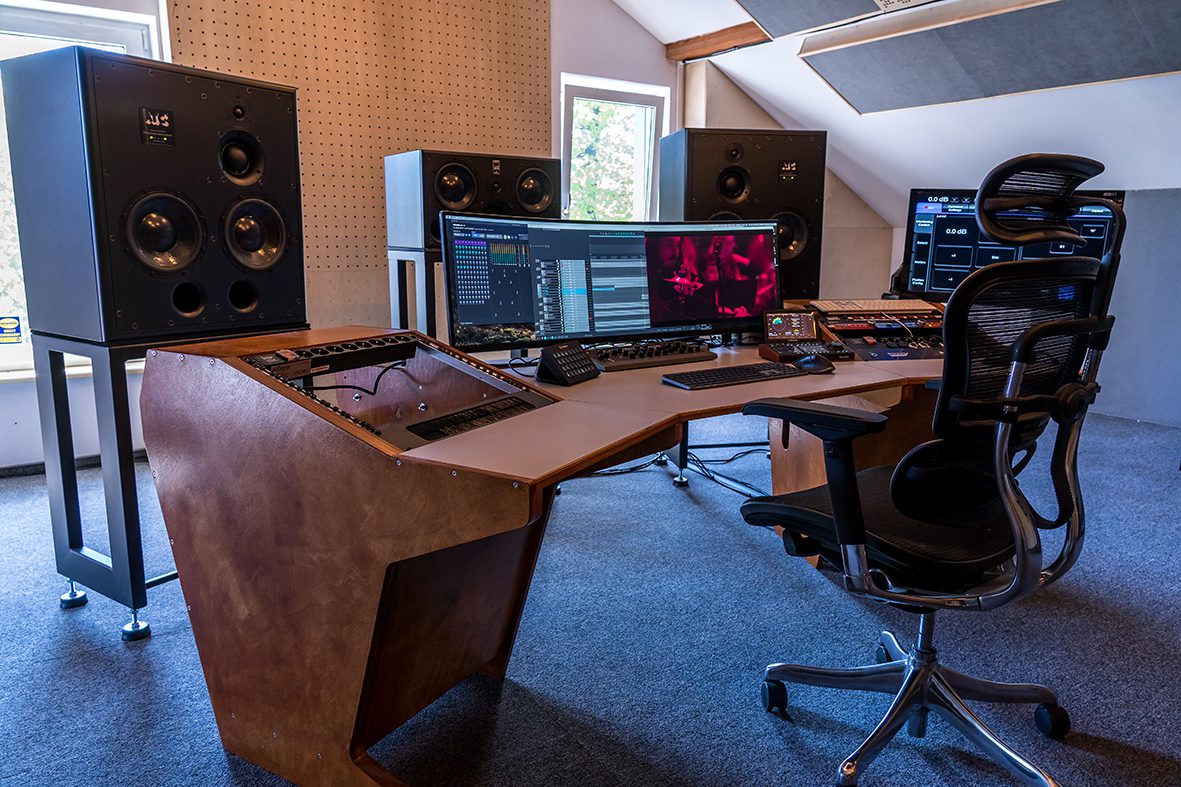
Studio 7.1.4 Around The Sound equipped with ATC Loudspeakers studio monitors in Dolby Atmos 7.1.4 configuration
SELECTION OF APPROPRIATE TOOLS
It's not just the room, but also the right tools that will allow you to realize the full potential of your Dolby Atmos studio.
Dolby Atmos Renderer
The Dolby Atmos Renderer is the centerpiece of any Dolby Atmos mixing system. It works in tandem with the DAW program, rendering the mix to any playback environment, based on the audio and positional metadata created in the DAW program.
Renders up to 128 inputs (including audio backing tracks and objects with metadata) for monitoring setups, and renders to standard channel-based layouts for both monitoring and content creation. It also creates Dolby Atmos master files used for encoding for final distribution to streaming services or Blu-ray.
The Dolby Atmos Renderer application includes all features from the previous Dolby Atmos Production and Mastering Suites.
ATC Loudspeakers studio monitors
The reference studio monitors of choice for the world's top engineers and producers, present in the best recording and production studios. They are valued above all for their extremely precise and detailed sound regardless of the volume level at which we work. This allows us to work faster and more efficiently.
If you're interested in details about ATC Loudspeakers technology, a comprehensive article can be found here.
We described all the benefits of working with high-end studio monitors in this article.
A list of prominent ATC users as well as details of the offer through which he can buy ATC monitors on preferential terms can be found at our website.
Solid State Logic Consoles
Solid State Logic consoles are natively prepared for Dolby Atmos formats. Both the input channels, output rails, monitor rails and effect processors work in formats ranging from stereo all the way up to 9.1.6.
You can use SSL mixing systems in the form of:
- standard control surfaces such as SSL System T S500, S400, S300
- applications Tempest Control App
- cloud-based audio production system T Cloud System
DirectOut processors and converters
DirectOut's range of powerful audio platforms features the highest sound quality, functionality and stability. Depending on how extensive your system is, you can choose the Prodigy series - a 2U unit with more expansion card slots, or Maven - a 1U unit with fewer slots. Whichever you choose, the quality, functionality and stability will remain the same.
You can use DirectOut Prodigy or Maven devices as:
- A processor to manage your Dolby Atmos listening system. With advanced filters, you can make fine adjustments to your system, add delays or adjust levels.
- The heart of your mixing system. With the USB.IO card, you can use the processors as the heart of your Dolby Atmos recording and mixing system. Prodigy and Maven can also work as an interface for Dolby Atmos files, providing the highest quality processing.
- Top quality converters. In one device you will combine analog, MADI optical, MADI coax, AoIP, RAVENNA, DANTE, AES/EBU, MILAN. No matter what standard you work in or switch to, DirectOut will stay with you forever, and thanks to the SRC function, you don't have to worry about working with different sample rates.
Calibration
PERFECTLY COHERENT MIX
Room calibration is designed to ensure the consistency of mixes created in a Dolby Atmos studio. By mixing objectively in the space, you will be assured that your mix will retain its consistency in any Dolby Atmos studio. What's more, it will retain it on any consumer device with the Dolby Atmos logo. If you already have a Dolby Atmos-ready studio contact us for calibration.
MAIN TASKS OF CALIBRATION
The first goal is to ensure consistent sound across all speakers in a room. The idea is that a sound object that is moved around the sound field should sound the same no matter where it is placed in the room or which speaker or speakers are used to reproduce it. You can use identical speakers but due to the acoustic properties of the room they will sound different depending on their location. This is made up of many factors, such as proximity to different reflective or absorbing surfaces, but as a result, the speakers out of the box will have a different sound depending on their location in the room, and this is something that needs to be corrected.
This is usually not a problem with stereo systems, since most rooms are fairly symmetrical on the x-axis, so acoustic conditions are similar for left and right speakers. However, it usually has a significant impact on the comparison of speakers at the front or back of the room, especially overhead.
The second goal is to ensure mix consistency between different mixing environments. By having clear guidelines for studio calibration when a mix is moved between rooms or played in consumer environments, the results can be more consistent and predictable, and thus closer to the original intent.
Calibration is the process of adjusting the level, equalization and delay so that the measured acoustic response of the speakers meets a certain standard. Calibration is usually done by implementing these parameters in the last punch of the audio chain before it reaches the listening monitors. Calibration can be done manually, when a trained engineer applies a correction based on his or her assessment of the measured response, or automatically, when software creates a correction after processing the measured response.
Calibration can be done in various ways. For example, a defined source of pink noise is played as a file placed in a DAW or from the Dolby Atmos Renderer application. It is routed to the specific loudspeaker under test, and the acoustic response is measured using the RTA analyzer. The RTA displays the measured frequency response, which is affected by many elements including the speakers, amplifiers, room acoustics and other elements in the studio. The measured frequency response includes both direct and reflected sound. We recommend using multiple microphones to measure and average the frequency response, as results will vary with small changes in location across the room, especially at low frequencies.

Soundscape studio equipped with ATC Loudspeakers studio monitors in Dolby Atmos 7.1.4 configuration
Join the elite
By mixing in Dolby Atmos, you open yourself up to huge opportunities to collaborate with artists from all over the world. Dolby Atmos is currently the best and most common audio format, which is very quickly becoming a standard in all productions, streaming platforms, and the number of devices compatible with this format is growing at an alarming rate. If you don't want to be left far behind, join the elite group of Dolby Atmos studios.
Benefits of mixing in Dolby Atmos
Benefits of mixing in Dolby Atmos:
- Music productions at the highest level. Object mixing in Dolby Atmos, unlike traditional surround mixing translates directly as the quality of the stereo format, so not only will your Dolby Atmos productions benefit from it, but your stereo mixes will also gain new space and depth
- Increasing competitiveness. By mixing in Dolby Atmos you are in a winning position standing up to traditional recording and production studios, which will directly translate into the number of clients and the number of projects.
- Support and development. For customers mixing in Dolby Atmos, we offer ongoing support, both in terms of equipment and content. We will help with troubleshooting, development or upgrades.
- Development and Training. Dolby cares about both the development of its products and the development of its users by giving you access to a huge knowledge base so you can get the most out of the tools at your disposal.
- Increase in the value of the studio. By investing in the latest technologies of the future, you are assured that you will not only not lose, but also gain.
- Advanced Projects. Dolby Atmos is an opportunity to work on advanced, inspiring projects where you will develop your skills and unleash your creativity.

Studio Render Cube equipped with ATC Loudspeakers studio monitors in Dolby Atmos 7.1.4 configuration
Broadcast
BROADCASTS IN DOLBY ATMOS
Dolby Atmos is not just about stationary recording studios, production studios, or broadcast stations. Dolby Atmos is present in state-of-the-art broadcast vans and no world-class event can take place without audio production in this format.
OB VAN
The specification of broadcast carts poses many challenges for designers to meet the requirements of the various formats. This is especially true for the limited amount of space available in most broadcasting vehicles, where many departments such as production, video production, levels, slomo, sound production, graphics, etc. must be accommodated. Therefore, already at the stage of designing a broadcast truck or upgrading it for Dolby Atmos, it is worth taking into account the recommended guidelines for the listening room and consulting Dolby Atmos specialists to make the mixes created on the truck, consistent with the mixes created in Dolby Atmos studios.

ATMOS sound cart by 120dB dedicated to Dolby Atmos 7.1.4 configuration
If you have questions about Dolby Atmos, please contact us!

 Polski
  English
  Slovenčina
  Čeština