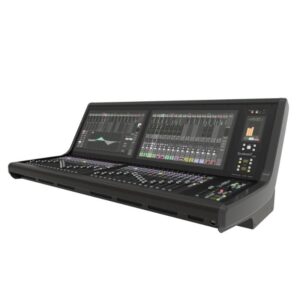
SSL Live L450


Next-generation OCP technology
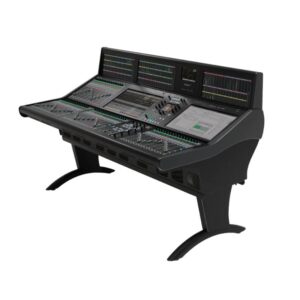
SSL Live represents decades of experience in creating the best studio consoles implemented to the specific requirements of live sound production. The result is an intuitive and ergonomically efficient design, with a set of unique features that give the performer complete control. The system allows operation from both a touchscreen and control surface. A single, ultra-bright, high-resolution 19-inch multi-touch screen is the heart of the console and can be used to configure both the system and routing, as well as create customized control surface layouts using a layer manager, automation interface, effect rack and two different views: channel view and console overview.
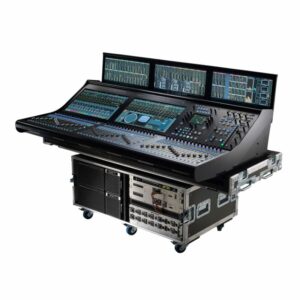
Based on the unique ergonomic design of the L200 console, like the new flagship L650 console, the L450 sits between the two in terms of computing power. The L450 is based on the same 19-inch multi-touch screen as the L550 Plus and L650, but features TaCo APP layers instead of Channel Control layers. It also retains the famous layout of three fader banks and cutouts for external screens, giving performers an ideal view of the stage without taking their eyes off the console.
The latest V5.0 software update introduces a host of new features and enhancements to the SSL Live platform. The V4.11 software introduced integrated control of the L'Acoustics L-ISA Immersive system, and V5.0 continues this by adding integrated control of Meyer Sound Immersive speaker systems via the SpaceMap Go application. New "Plus Processing Packs," improved control of third-party devices, new processing tools; Blitzer and Sorcerer, and Path Recall Safe show the manufacturer's commitment to keeping all SSL Live consoles compatible and the latest technologies.
Watch the video to learn more about the new L450 and L650 consoles and the enhancements offered by SSL Live V5.0 software.
TaCo app and external touchscreen
Tablets can be used to provide additional touchscreen control. It is possible to control channels and the Effect Rack using the SSL TaCo control app for tablets. The L450 offers a dedicated tablet mount next to the 19-inch multi-touch screen, keeping it in the line of sight of the performer.
Additional screens connected to external PCs or touchscreen laptops with SOLSA can be mounted on the console arm for even more touchscreen control options.
Architecture
The L450's DSP is built on next-generation Optimal Core Processing (OCP) technology and is extremely flexible. The console has 856 inputs and 856 outputs. It has 240 mixing channels at 96 kHz. These channels can be assigned as Inputs, Stem Groups, Auxes and Masters as needed and configured from mono, which uses one track, to 5.1, which uses six tracks.
The 32 input / 36 output matrix also has its own dedicated processing and can be split into four separate smaller matrices if needed. All 36 output tracks of the matrix have available high and low pass filters, 4-band EQ, 2-second delay and unique all-pass filters. This is in addition to two inserts that can be used with both the internal Effect Rack and external devices.

Local and external mic/line preamps use SSL's patented technology to deliver the highest quality signal to the console. The circuits are DC-coupled (no electrolytic capacitors in the signal path) and have high input impedance. The gain of the microphone preamp is controlled extremely precisely in over 16,000 steps, providing completely smooth regulation and extremely low distortion. See for yourself by conducting listening tests.
L450 local analog I/O configuration: 16 microphone/line inputs, 16 line outputs, 2 headphone/monitor outputs. AES/EBU digital I/O configuration: 4 pairs of inputs and 4 pairs of outputs. AES/EBU inputs/outputs have fully variable sample rate conversion.
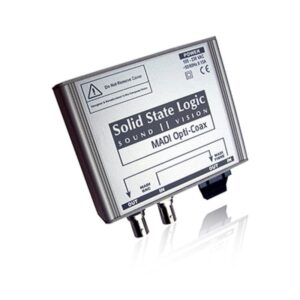
Standard MADI port configuration: 6 redundant coaxial and 2 fiber-optic (non-redundant) pairs. If redundancy is not required, these connections can be independent, providing a maximum of sixteen ports. In addition, a separate optical MADI port (out/in) is available, designed for use as an "FX loop" to connect an external FX device, such as a system using Waves Multirack or a VST effects host. The standard configuration offers SSL Blacklight II connectors. A Dante card is also available, offering 32x32 channels of I/O at 96 kHz (or 64x64 channels at 48 kHz) via a redundant Dante connection. A redundant pair of SSL X-Light connectors provides 256 bidirectional channels at 96 kHz between the console and stage via a single cable with reinforced connectors. There are also MIDI, LTC, Wordclock and GP I/O connectors on the rear panel. The console has redundant power supplies.
 Polski
  English
  Slovenčina
  Čeština