In the dynamic world of audio realization, where we currently have a plethora of digital standards, the demands of artists and system engineers increase with each tour, a rental company must answer some extremely important questions: „What is the best DSP processor to choose?”, „What is the best audio matrix?”, „Which audio converter is the most versatile?”, „Is it possible to have the best dsp processor, matrix and audio converter in one device?”, „Do we even need an advanced DSP processor and signal switcher for different audio formats?”.”
The answer to all these questions is simple: YES, DirectOut. Today's „management system” is no longer just a matter of bandwidth division (crossover). It's a command center role that has to reconcile safety, format conversion, different operating frequencies and top sound quality.
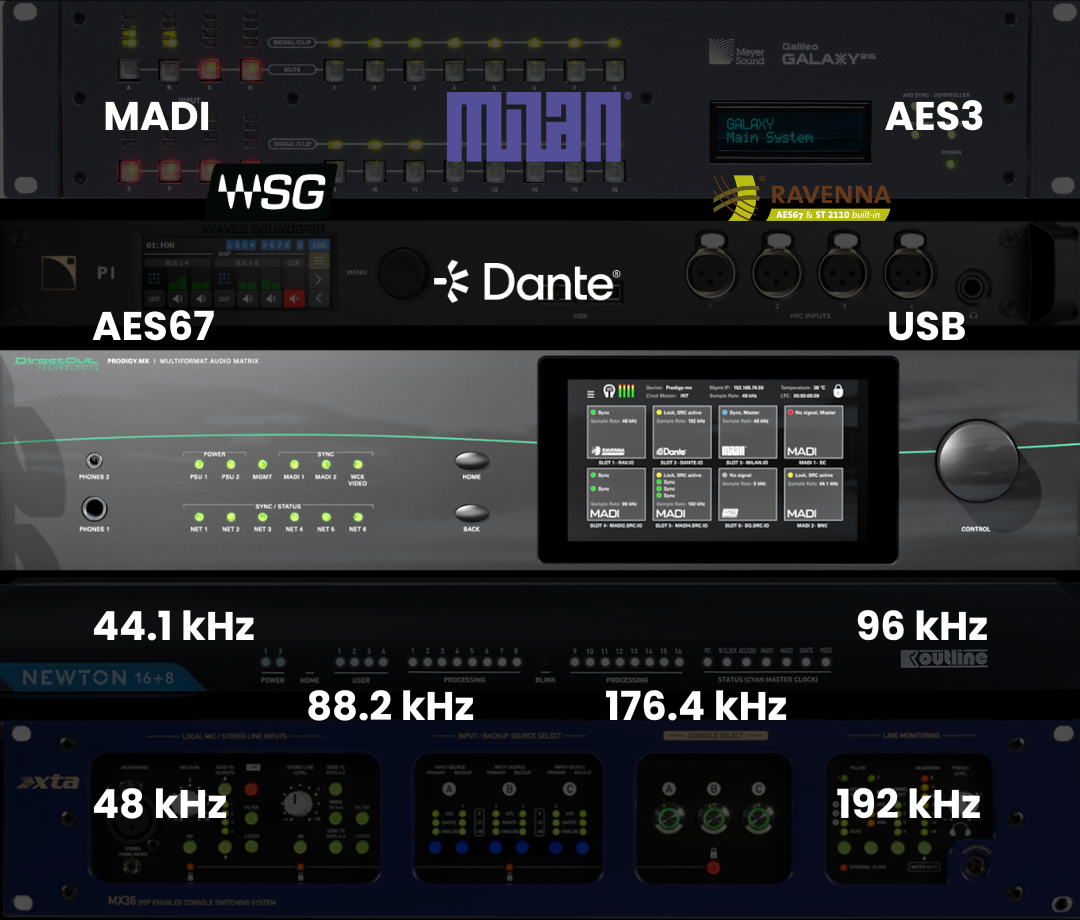
This article is a confirmation of the above answer, which is based on the current trends and requirements of the public address market and the features of top brand equipment: Meyer Sound Galaxy, Outline Newton, L-Acoustics P1, XTA MX36 and functionality leader DirectOut Prodigy, Maven and ACE.
1 Tower of Babel: Protocols and Conversion
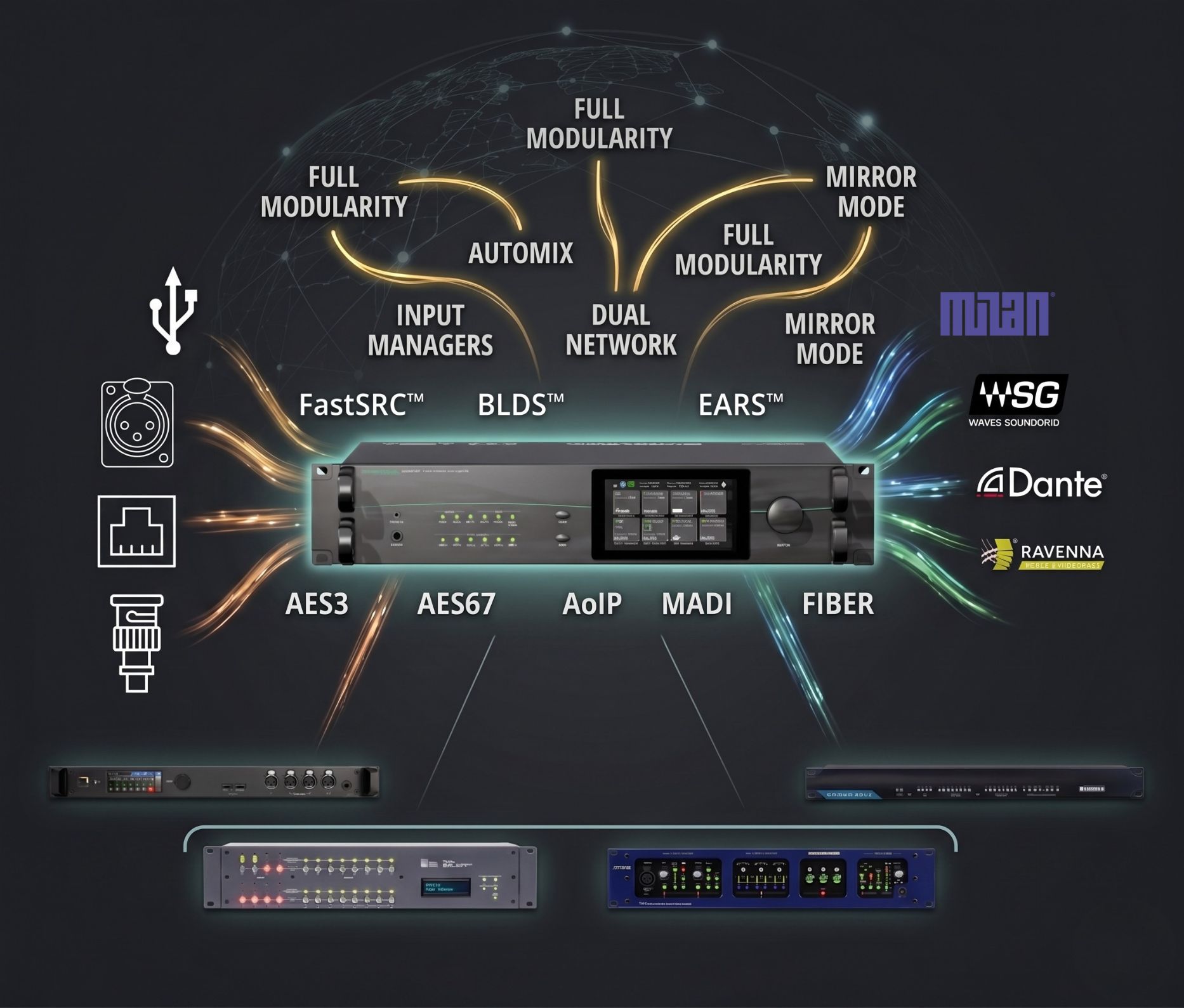
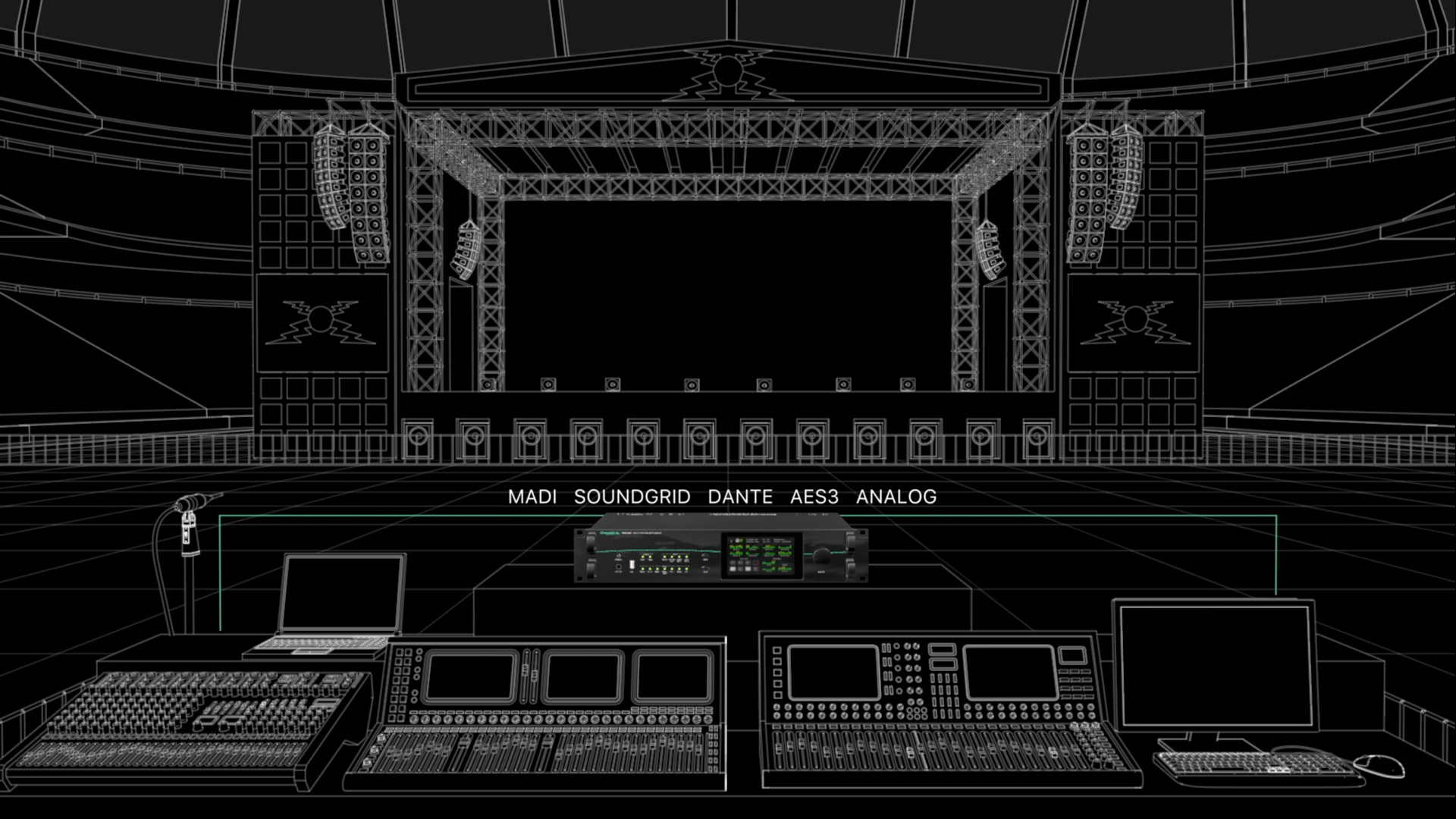
One of the main problems of modern rentals is the „digital Tower of Babel.” At one festival, there may be consoles sending out signal after Dante, Soundgrid and/or AES/EBU, a transmission truck requiring MADI or RAVENNA, a PA system that works on AVB/Milan, and a guest realizer with an analog outboard such as equalizers, compressors, preamps or whole channel strips.
Not all of the commercially available devices give you the ability to work with so many formats. Hardly, most of these devices work in the FIX domain - that is, they have fixed options for IN and OUT source connections, most often analog, AES/EBU and Dante. The processors offered by the brand DirectOut have the advantage of a modular design; that is, they have the ability to implement cards in every possible audio format available (available cards for Prodigy and Maven). This is a kind of universal format translator, which we can adapt individually even to the event according to the needs and most importantly separating the clocks.
Getting back to the substance, i.e. what the rental company currently needs, it is worth taking care of a few features in the audio processor / matrix:
- Protocol support: a modern processor must support Dante, Milan (AVB), Ravenna, MADI, Soundgrid, AES/EBU and traditional Analog.
- USB Audio: Increasingly, processors are acting as an audio interface (such as in the L-Acoustics P1 or DirectOut Prodigy or Maven) for metering (Smaart) or multi-track recording, eliminating the need for external sound cards.
This way, the sound company doesn't have to worry about what format the FOH signal will come in - the processor will accept everything and give back what the amplifiers need.
2 The heart of the system: DSP and PA tuning
Another reason to own a dsp processor/array is to fine tune a sound system. Each of the devices in question offers powerful processing power, but they differ in their approach and capabilities. A MUST HAVE for our processor:
Filters and their types:
- IIR - The main feature is their recursiveness. This means that the output signal depends not only on current and past input samples, but also on previous output samples. In a nutshell: the filter „remembers” its previous steps and loops them, which theoretically makes the impulse response last indefinitely (hence the name). As a result, these filters perfectly mimic the behavior of analog electronic circuits
- FIR - Unlike IIR, FIR filters have no feedback. The output signal depends only on the present and past input samples. This filter „pushes” the signal through a series of multipliers, which is mathematically called a splice. To achieve precise cuts, an FIR filter needs thousands of such points, which puts a heavy load on the processor, so not every commercially available DSP processor dedicated to the sound reinforcement market will be able to open more such instances.
What about latency? Precision tools do not like compromises.
Comparison: FIR vs IIR
| Feature | FIR (Linear Phase) filter | IIR (Zero Latency) filter |
| Phase | Linear (no phase distortion) | Shifted (phase distortion) |
| Delay | Very high | Minimum / zero |
| CPU resources | High | Low |
| Artifacts | Pre-ringing (echo before sound) | Post-ringing (ringing after the sound) |
| Stability | Always stable | May be unstable |
Cooperation with Smaart software:
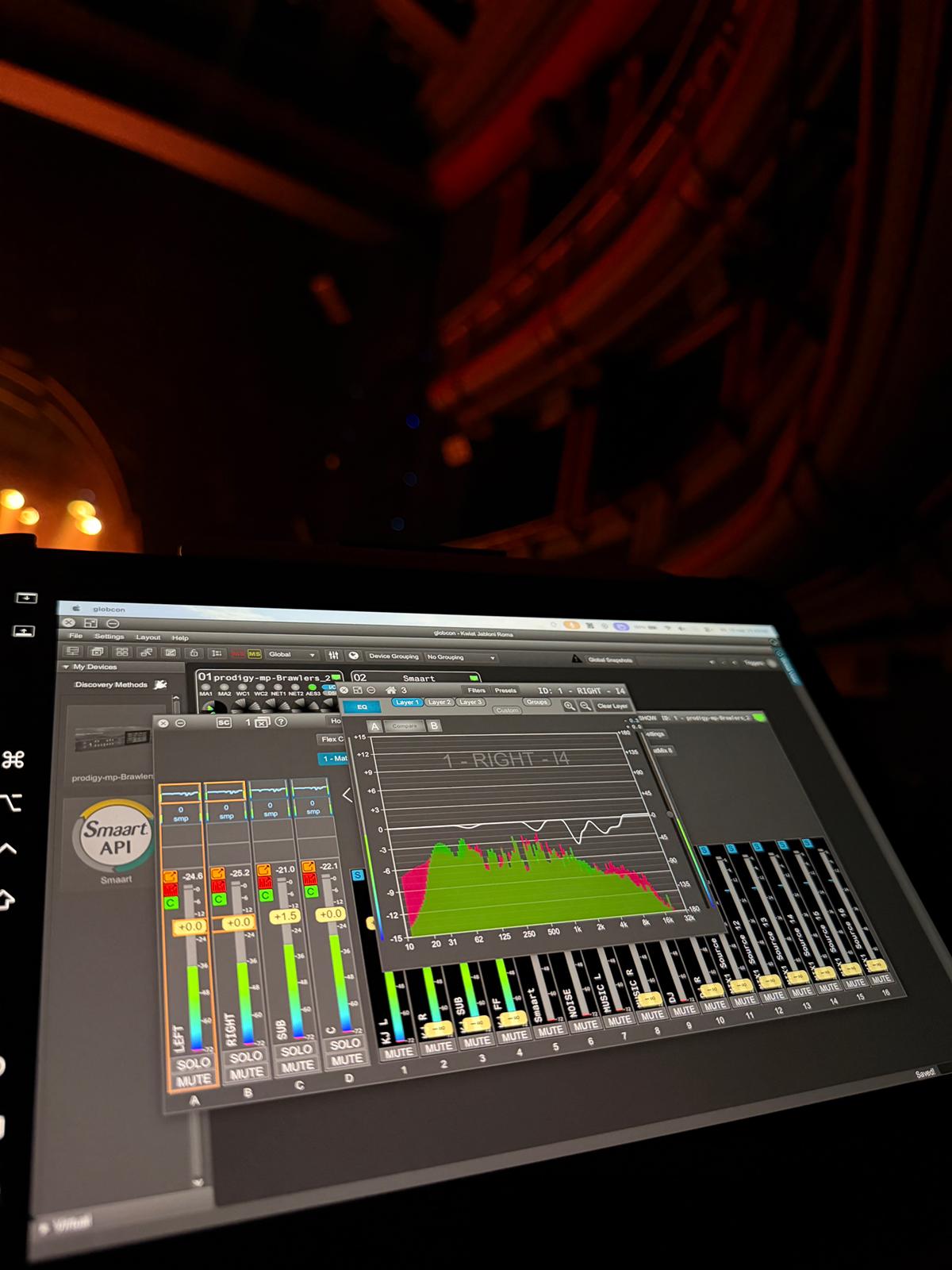
Imagine that your dsp processor is integrated with Smaart software and you can have all your data in one window. DirectOut is not trying to kick down an open door - instead of creating its own analyzer, the Globcon software that serves DirectOut-branded processors „gets along” with Smaart through its API. This allows you to display measurement data directly on the equalization (EQ) window of a PRODIGY, MAVEN or ACE processor
- Graphic Overlay (Overlay): You see the frequency response curve (RTA or Transfer Function) from Smaart directly „below” the EQ filters in the processor panel.
- Real-time decisions: You see the result of your correction (e.g., cutting out resonance with an IIR filter) on a live body, without switching windows between programs.
Working with different clocks (SRC):
In a festival environment, we often have to deal with different sample rates (44.1, 48, 96,192 kHz). Function Fast SRC (Sample Rate Conversion), present in advanced DSP units such as DirectOut Prodigy or Maven, allows seamless combination of signals from different sources with different clocks without digital crackles (glitches). Such a feature also gives you the freedom to configure independent AoIP networks (e.g., Dante) when connecting the network responsible for live execution with the network responsible for transmission (transmission cart).
3 Security Above All: Redundancy and Other Features.
The most important function for a rental company is reliability. Failure of the main signal during a concert is a nightmare. Here the role of the „switcher” is crucial.
Devices such as XTA MX36 were designed specifically for simple console switching. However, in large systems, automation of this function is needed so that the system engineer or FOH implementer doesn't have to think about keeping an eye on additional things.
- Clock Redundancy: If the Dante clock goes dead, the processor should smoothly switch to the internal clock or a clock from another source; MADI, AES, etc. Just giving the information to the person in charge, and not lead to an interruption of operation.
- Automatic Switchover (Failover): The system must detect silence or a digital error at input A and immediately switch to input B without audible interruption.
So which of the processors and matrices on the market have true power redundancy, signal switching, clock loss, and the option to work in mirror mode for large live and television productions ?
You'll find all of the above capabilities in Prodigy and Maven. DirectOut even came up with its own way of switching „lost” signals, which it patented and called the EARS (Enhanced Automatic Redundancy Switching) function, which works well both as a function of the main processor but also as a playback switcher.
It's a „game changer” in security. EARS is not a simple switchover in the absence of a signal. It's advanced logic that can analyze pilot tone, digital status (BLDS) or audio level to perform a perfect, inaudible switchover to backup. No competitor device offers such advanced redundancy trigger logic.
More about the EARS feature itself:
Other functionalities that strengthen the security of your live operation:
- Input Managers: They allow you to create complex scenarios. E.g., „If the Dante A input loses clock, switch to MADI C, but only if MADI C has an active signal.” This is a level of control unattainable for the XTA or Meyer Sound brand.
- Mirror Mode: The ability to fully control the „Main” and „Backup” unit as one unit. You change the EQ on the main processor, and the backup does the same in real time.
Comparison of giants: Who offers the most?
Key features of the devices in question:
| Feature | Meyer Galaxy | Outline Newton | L-Acoustics P1 | XTA MX36 | DirectOut Prodigy / Maven |
| Main objective | Meyer Systems | Matrix/FPGA | L-A Systems | Console switch | Management of PA systems of any manufacturer / Broadcast |
| Modularity | No | Limited | No | No | Full (I/O cards) |
| Milan service | Yes | Yes | Yes | Not | Yes |
| Number of inputs | Average | Average | Small | 3x Console | Giant (up to 416 x 420) |
| FIR filters | Yes | Yes (WFIR) | Yes | Yes | Yes |
Why does DirectOut outclass the competition?
Although Meyer Sound Galaxy, L-Acoustics P1 or Outline Newton are outstanding devices in their respective ecosystems. DirectOut Prodigy.MP and its smaller brother Maven sets a whole new standard, becoming the world's most functional tool.
Here are the functions they put DirectOut in a leading position, outclassing the solutions of competitors (Meyer, Outline, L-Acoustics, XTA):
1. unrivaled modularity and formats
Unlike closed architectures (e.g., Galaxy or P1, where ports are predefined), Prodigy.MP is fully modular.
- Interchangeable cards: You can configure the device for a specific order - today you need 64 channels of MADI and Analog, tomorrow Dante and AES.
- DUAL Network cards: Unique ability to install cards that support different network protocols simultaneously. You can have in one machine Dante i Milan (AVB), or two independent Dante networks, creating a bridge between worlds that other processors can't connect.
- Globcon and AutoMix: Management through software Globcon integrates control of multiple devices of different brands. In addition, the built-in AutoMix makes the Prodigy or Maven work well not only at concerts, but also at corporate events and conferences, automatically mixing panel discussions - a feature that you can't find in typical PA processors like Newton or Galaxy.
Summary
A rental company needs a processor to sleep soundly. Devices such as Meyer Galaxy or L-Acoustics P1 are great when you work exclusively within a single brand of speaker and don't have a lot of expectations regarding sundry audio formats, true redundancy or automation of functions such as signal loss or clocking. However, as a universal „brain” of the whole system, supporting conversion, top-notch security and any audio format, DirectOut Prodigy.MP or Maven is currently an unrivaled solution in the global market. This is confirmed by the fact that DirectOut brand equipment is working at the biggest festivals with the best in the industry.